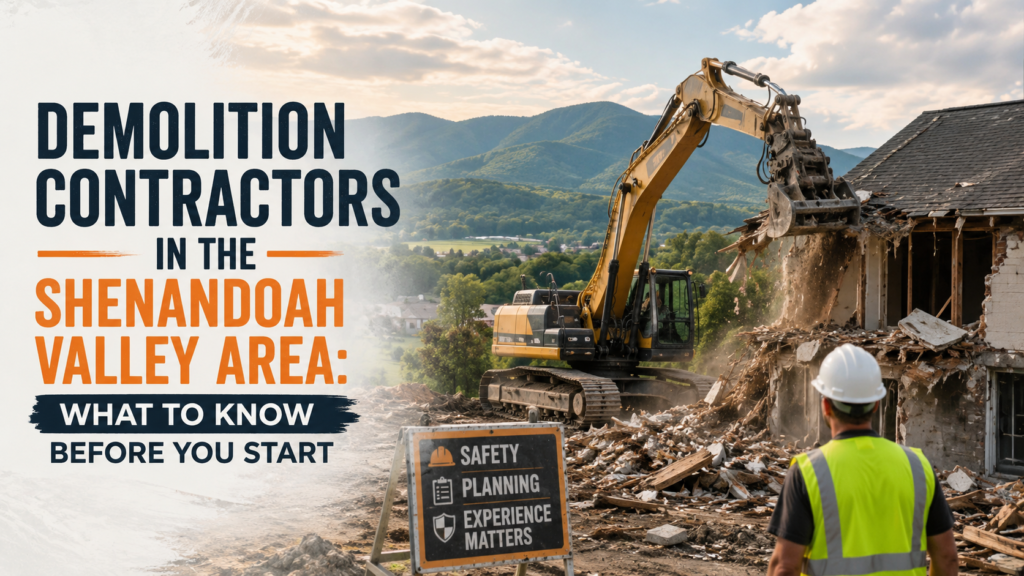
The Shenandoah Valley stretches through the heart of Virginia, encompassing a distinctive mix of historic communities, agricultural landscapes, rural properties, and growing suburban developments. From the northern reaches near Winchester and Front Royal to the southern communities of Staunton and Waynesboro, the region presents a unique set of characteristics that shape how Demolition Contractor Shenandoah Valley Area are planned, executed, and regulated. For anyone considering a demolition project in the Shenandoah Valley, understanding the local landscape physically, historically, and regulatory is the starting point for a successful outcome.
The Shenandoah Valley Demolition Market
The Shenandoah Valley includes several distinct counties Shenandoah, Warren, Frederick, Page, Rockingham, Augusta, and others each with their own zoning codes, building departments, and permit requirements. The region is served by a mix of locally based demolition companies and contractors from larger nearby markets like the Northern Virginia and Washington D.C. metro area who are willing to travel for significant projects.
Residential demolition is a common service in the Valley. Old farmhouses, agricultural outbuildings, deteriorating barns, sheds, mobile homes, and outdated residential structures are regularly removed as property owners modernize, redevelop, or simply clear land that has accumulated structures over generations. The agricultural heritage of the Valley means barn demolition and farm outbuilding removal are particularly common requests that many local contractors specialize in.
Commercial demolition also occurs throughout the Shenandoah Valley as the region attracts new businesses, retail development, industrial tenants, and service sector expansion. Communities like Winchester, Harrisonburg, and Staunton have experienced commercial growth that regularly requires demolition of older structures to make way for modern facilities.
Virginia Licensing Requirements for Demolition Contractors
Virginia regulates demolition work through its Department of Professional and Occupational Regulation (DPOR). General contractors performing demolition work exceeding $1,000 in value must hold Class A, B, or C contractor licenses. Class A licenses authorize any construction project without value limitations, Class B covers projects up to $120,000, and Class C covers projects up to $10,000.
Asbestos abatement in Virginia requires separate licensing through the Virginia Department of Labor and Industry, with different license categories for contractors, supervisors, and workers performing abatement. The Shenandoah Valley, with its significant stock of older structures many dating to the 19th and early 20th centuries means asbestos abatement is an important consideration in many demolition projects here.
Lead paint remediation may require EPA RRP (Renovation, Repair, and Painting) certification or Virginia Department of Health permits for certain project types and scales. Again, the age of Valley structures makes lead paint a realistic concern that qualified demolition contractors must be prepared to address.
Historic Structures and the Shenandoah Valley
One of the most distinctive aspects of demolition work in the Shenandoah Valley is the presence of historically significant structures. The Valley was a corridor of Civil War activity, and many properties contain structures homes, barns, mills, stone walls with documented historical significance. Before demolishing any older structure in the Valley, property owners should investigate whether the structure is listed on, or eligible for, the Virginia Landmarks Register or the National Register of Historic Places.
Even structures that are not formally listed may be subject to local historic preservation review, particularly in communities like Luray, Woodstock, Strasburg, and the historic districts of larger Valley cities. Demolition permits in these areas may require review by a historic preservation commission or local planning body. Working with a demolition contractor familiar with the Valley’s historic preservation landscape can help property owners navigate these considerations before project commitments are made.
Common Types of Demolition Projects in the Shenandoah Valley
Selective and interior demolition is among the most frequently requested services. Many Valley properties contain older structures that are structurally sound on the exterior but require comprehensive interior removal before renovation can proceed. This type of demolition removing walls, ceilings, flooring, fixtures, and mechanical systems while preserving the shell requires precision and experience that distinguishes quality contractors from those focused solely on speed.
Full residential demolition is performed when structures are beyond economical rehabilitation, or when redevelopment plans call for a clean site. In the Valley, this often involves older farmhouses, mobile homes, or deteriorated structures on rural parcels where owners are planning new construction.
Concrete removal is another common standalone service. Deteriorated driveways, old foundations, concrete slabs from demolished outbuildings, and agricultural concrete structures are regularly removed across the region. Contractors with appropriate equipment excavators with hydraulic breakers, concrete saws, and hauling capacity handle concrete removal efficiently.
Pool removal has become an increasingly common request across Virginia, including the Shenandoah Valley. Older in-ground pools that have reached the end of their useful life are removed through either full excavation or a partial fill process. Local contractors familiar with Valley soil conditions which vary significantly across the region can advise on which approach is appropriate for a specific site.
Preparation Steps for Shenandoah Valley Demolition Projects
Successful demolition projects in the Shenandoah Valley begin with thorough preparation. Property owners should first confirm access for equipment Valley roads and rural property lanes vary widely in their ability to support heavy equipment, and some sites require site preparation before demolition machinery can even reach the structure. Many Valley demolition contractors conduct site visits specifically to assess access before committing to project timelines.
Utility disconnection must precede any demolition. The appropriate utility providers electricity, gas, water, and telecommunications must confirm disconnection of all service connections to the structure before work begins. In rural Valley areas where well water and septic systems are common, well abandonment and septic system decommissioning protocols must also be followed.
Permit requirements vary by county in the Valley. Property owners should confirm with their county building department what permits are required for the planned demolition scope. Many Shenandoah Valley contractors handle permit acquisition as part of their service, which streamlines the process for property owners unfamiliar with local requirements.
Frequently Asked Questions About Demolition in the Shenandoah Valley
How are rural demolition projects in the Valley different from urban ones? Rural demolition often involves more complex site access, agricultural structure types like barns and silos that require specialized approaches, and potentially greater distance from disposal facilities. Contractors with specific Shenandoah Valley experience understand these distinctions.
Are demolition permits required in all Shenandoah Valley counties? Permit requirements vary by jurisdiction. Most counties require permits for full structure demolition, and some require them for partial demolition or significant interior work as well. Your contractor should be familiar with the requirements in the specific county where the project is located.
What happens to the materials from a demolished Valley structure? Debris is typically hauled to licensed disposal facilities, sorted for recycling where possible, or in rural settings sometimes burned under appropriate open-burn permits. Salvageable materials from older Valley structures antique lumber, stone, brick, architectural elements may have significant value and can often be sold or donated.